Skull and bones
Gothic crosses and marks
Gothic name borders
Dark kaomoji
Fire and flame
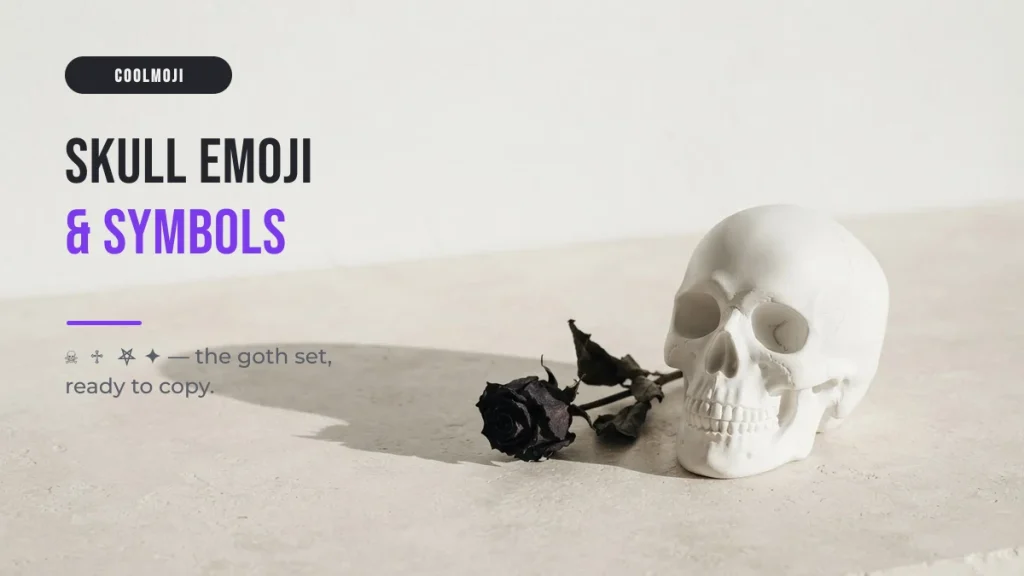
On social media the skull emoji 💀 almost never means death. It means laughing — short for “I’m dead”, the reaction that replaced 😂 for a younger audience. Tap any symbol above to copy it, including the text skull ☠ and the gothic name borders further down the grid.
Last updated: 15 October 2026 · COOLMOJI Editorial Team
What 💀 means when someone sends it
💀 is a laughter marker. “I’m dead” has meant “that was extremely funny” in English slang for decades, and the emoji is the shorthand for it. Somebody replying to your joke with three skulls is complimenting you, not threatening you.
The tone flips with context. Under a joke it is laughter; attached to a genuinely bleak statement it reads as dark humour; in a gaming chat it can simply mean somebody died. The emoji did not change — the sentence around it did.
💀 and ☠️ are two different characters
They look related and behave completely differently, which is worth knowing before you paste one into a name.
| Symbol | Code point | How it reads |
|---|---|---|
| 💀 | U+1F480 SKULL | Laughing, “I’m dead”. Always a colour emoji. |
| ☠️ | U+2620 + U+FE0F | Danger, poison, pirates. Genuinely ominous. |
| ☠ | U+2620 on its own | The same skull as text — takes your font’s colour. |
That last row is the useful one for decoration. Without the variation selector, ☠ stops being a picture and becomes a letter-like glyph that sits neatly inside a name instead of towering over it.
Skull emoji as text: 💀 is almost always drawn as a colour picture, whatever you do. For a skull that copies as plain text, use ☠ followed by the text selector U+FE0E (☠︎), or one of these:
Gothic borders you can wrap around a name
A gothic border is a symbol pair repeated either side of your text. The ornaments below are ordinary Unicode characters, so they copy and paste like letters.

- ⋆༺ name ༻⋆ — Tibetan brackets, the most widely supported of the ornate pairs.
- ꧁ name ꧂ — Javanese brackets, the classic gaming-name frame.
- ♱ name ♱ or ⛧ name ⛧ — a single mark either side, short enough for tight fields.
The softer counterpart to this set — the same border trick built from heart symbols — reads very differently for the same effort. Two warnings worth taking seriously. Long borders are the first thing a name field truncates, so a nine-character frame around a nine-character name often arrives cut in half. And game name fields in particular tend to allow a narrow whitelist of characters — if the whole name is rejected, remove the ornaments first and add them back one at a time.
What these gothic symbol strings mean
People search the meaning of a few gothic strings more than any others. The honest answer is that none of them hides a message: each one is a frame or a mood built from characters of old writing systems. Here is what every piece really is, so you can tell what you are pasting.
⛧⃝𓄃 meaning
⛧⃝𓄃 is an inverted pentagram inside a circle, followed by an Egyptian hieroglyph of a horned animal head. In goth and occult-themed profiles it reads as “dark” or “rebel”; it does not belong to any language and carries no fixed meaning. The circle is not a separate symbol: U+20DD is a combining mark that draws a ring around the character before it, so some phones show ⛧ and the circle side by side.
| Piece | Code point | Unicode name | What it does here |
|---|---|---|---|
| ⛧ | U+26E7 | INVERTED PENTAGRAM | the main symbol |
| ◌⃝ | U+20DD | COMBINING ENCLOSING CIRCLE | draws a ring around ⛧ |
| 𓄃 | U+13103 | EGYPTIAN HIEROGLYPH F005 | horned head (Gardiner sign F5) |
𒄆𓁹✞𒀱✞𓁹𒄆 meaning
𒄆𓁹✞𒀱✞𓁹𒄆 is a mirrored border, read from the middle out: a Sumerian cuneiform sign in the centre, a cross on each side, an Egyptian eye hieroglyph, and another cuneiform sign at each end. It is decoration — the eyes and crosses give it a watchful, mystical look — and the spaced version 𒄆𓁹 ✞ 𒀱 ✞ 𓁹𒄆 is the same characters with gaps so it breaks less often in narrow fields.
| Piece | Code point | Unicode name | What it does here |
|---|---|---|---|
| 𒄆 | U+12106 | CUNEIFORM SIGN GI4 CROSSING GI4 | outer ends |
| 𓁹 | U+13079 | EGYPTIAN HIEROGLYPH D004 | the eye (Gardiner sign D4) |
| ✞ | U+271E | SHADOWED WHITE LATIN CROSS | crosses either side |
| 𒀱 | U+12031 | CUNEIFORM SIGN AN PLUS NAGA SQUARED | centre piece |
Cuneiform and hieroglyph fonts are missing on many older phones, so this border is one of the most likely to arrive as empty boxes. Check it on the device where it will be seen before you commit to it as a name.
꧁⎝ 𓆩༺✧༻𓆪 ⎠꧂ meaning
꧁⎝ 𓆩༺✧༻𓆪 ⎠꧂ is a name frame with a star in the middle, built in layers: Javanese title ornaments on the outside, bracket hooks from maths typesetting, a pair of mirrored Egyptian hieroglyphs, then Tibetan brackets around ✧. Replace the ✧ with your name — that is what the empty space is for. The inner part on its own, ⎝ 𓆩 ✧ 𓆪 ⎠, is the shorter version people also search.
| Piece | Code point | Unicode name | What it does here |
|---|---|---|---|
| ꧁ | U+A9C1 | JAVANESE LEFT RERENGGAN | outer left ornament |
| ⎝ | U+239D | LEFT PARENTHESIS LOWER HOOK | left hook |
| 𓆩 | U+131A9 | EGYPTIAN HIEROGLYPH L006 | left wing |
| ༺ | U+0F3A | TIBETAN MARK GUG RTAGS GYON | left bracket |
| ✧ | U+2727 | WHITE FOUR POINTED STAR | the gap for a name |
| ༻ | U+0F3B | TIBETAN MARK GUG RTAGS GYAS | right bracket |
| 𓆪 | U+131AA | EGYPTIAN HIEROGLYPH L006A | right wing |
| ⎠ | U+23A0 | RIGHT PARENTHESIS LOWER HOOK | right hook |
| ꧂ | U+A9C2 | JAVANESE RIGHT RERENGGAN | outer right ornament |
♡☠༒✞🕸𖤐 meaning
♡☠༒✞🕸𖤐 is a “soft goth” mood row: a heart, a skull and crossbones, a Tibetan punctuation mark, a cross, a spider web emoji and a star-like letter from the Bamum script of Cameroon. Together they say cute but dark. Only 🕸 is an emoji; the rest are text and take the colour of your font.
| Piece | Code point | Unicode name | What it does here |
|---|---|---|---|
| ♡ | U+2661 | WHITE HEART SUIT | heart outline |
| ☠ | U+2620 | SKULL AND CROSSBONES | skull, as text |
| ༒ | U+0F12 | TIBETAN MARK RGYA GRAM SHAD | ornament |
| ✞ | U+271E | SHADOWED WHITE LATIN CROSS | cross |
| 🕸 | U+1F578 | SPIDER WEB | the only emoji |
| 𖤐 | U+16910 | BAMUM LETTER PHASE-D NGKEURI | used as a star |
☠️🔥 meaning
☠️🔥 pairs the skull and crossbones emoji with fire. In comments it means something is brutally good — “this is fire, it killed me” — or a comeback that was savage. Unlike 💀 on its own, which mostly means laughing, the fire tips it towards praise.
When the skull shows as an empty box
An empty box means the font on that device has no drawing for that character. The character is intact and still on your clipboard; only the display failed. Older Android builds and desktop browsers with limited symbol fonts are the usual places this happens, and pasting into a social app normally fixes it.
This is the reason we never remove an unusual glyph from a set just because it looks broken in a preview — it very often renders perfectly on the phone where it will actually be used. More on how we check that in our editorial process.
Frequently asked questions
Does 💀 mean someone died?
Almost never in casual conversation. It marks laughter — “I’m dead” — in the same way 😂 once did. Read the surrounding message before assuming anything darker.
What is the difference between 💀 and ☠️?
💀 is U+1F480 SKULL and reads as laughter. ☠️ is U+2620 with an emoji selector and reads as danger or poison. They are separate characters with separate tones.
Why does my gothic name get rejected in a game?
Most game name fields accept only a short whitelist of characters. Ornamental brackets fall outside it. Try the plain text skull ☠ on its own, or drop the border entirely.
Are these skull symbols free to use?
Yes. They are characters in the Unicode Standard, not artwork, so there is nothing to license. Browse the wider library on COOLMOJI.