💡 Tip: click anything to copy it instantly.
Shared by visitors
Ideas other people saved for this word. Click one to copy it.
🆕 Just added
An emoticon is a face typed from keyboard punctuation, like :-). A kaomoji is a Japanese-style face built from wider text characters and read upright, like (^_^). An emoji is a picture character with its own Unicode code point, like 😊. A symbol is any other Unicode character — ★, ♡, ☾ — that takes the colour of the text around it. Below are 157 examples of all four to copy and compare.
Last updated: 2 October 2026 · COOLMOJI Editorial Team · dates and code points checked against unicode.org and Wikipedia
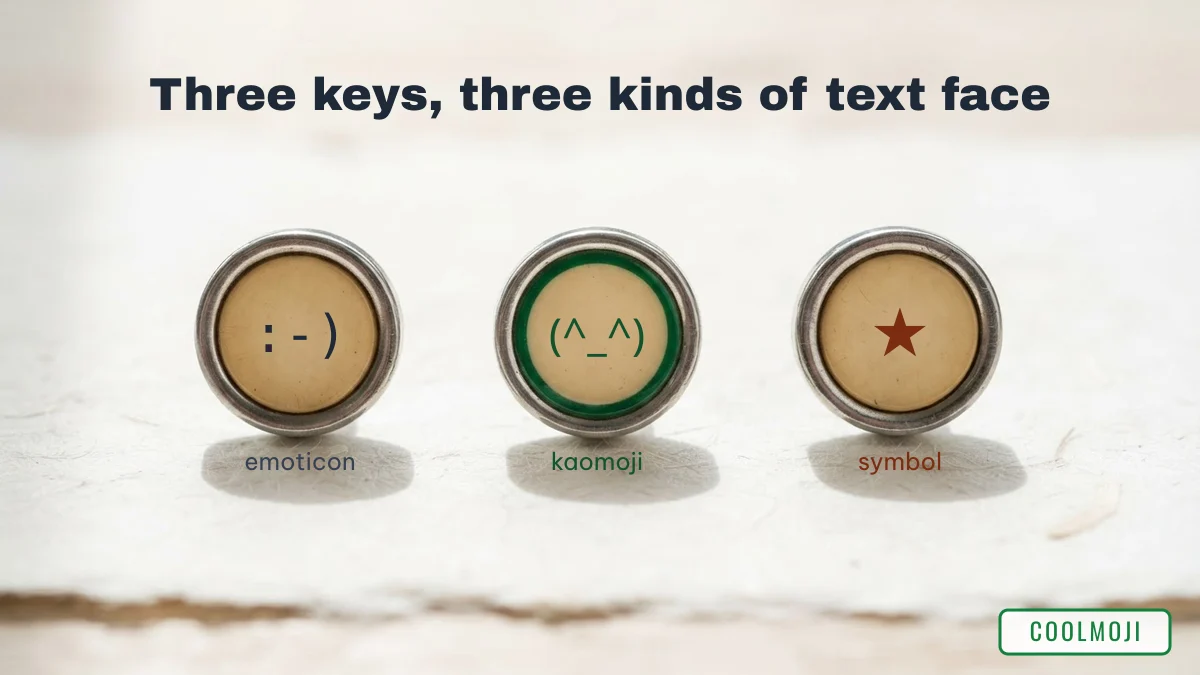
Emoji vs kaomoji vs emoticon vs symbol at a glance
| Emoticon | Kaomoji | Emoji | Symbol | |
|---|---|---|---|---|
| Example | 🙂 | (^_^) | 😊 | ☺ |
| Made of | ASCII punctuation | Several Unicode text characters, often Japanese or other scripts | One code point or a joined sequence with a colour picture | One Unicode text character |
| Read | Sideways (tilt your head) | Upright | As a picture | As a character |
| Colour | Same as the text | Same as the text | Full colour, drawn by the phone | Same as the text |
| Looks the same everywhere? | Yes | Mostly; depends on fonts | No — Apple, Google and Samsung each draw their own | Mostly; depends on fonts |
| Origin | Proposed by Scott Fahlman, 1982 | Japanese online communities, 1980s | Japanese mobile phones, late 1990s; in Unicode since 2010 | Printing and computing symbols, encoded in Unicode since 1991 |
What is an emoticon?
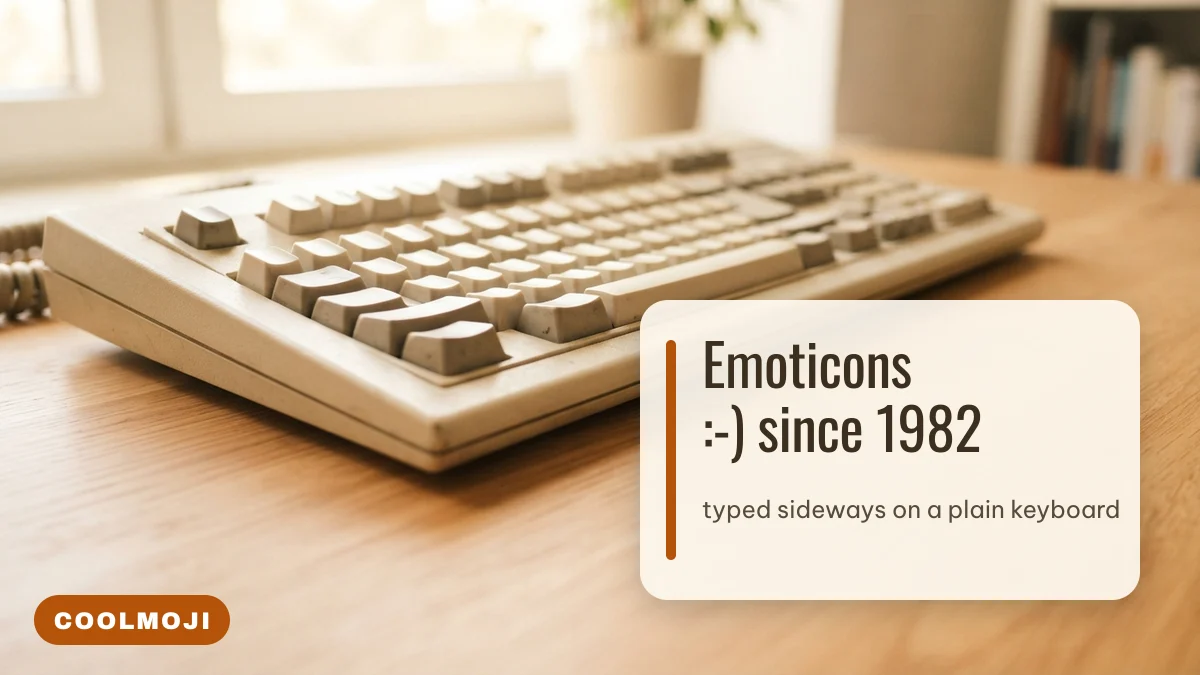
An emoticon is a facial expression typed with ordinary keyboard punctuation and read sideways: :-) is a smile once you tilt your head to the left. Computer scientist Scott Fahlman proposed 🙂 and 🙁 on a Carnegie Mellon University message board on 19 September 1982, to mark jokes and serious posts, and the idea spread from there. Because emoticons use only basic ASCII characters, they work on every device ever made — although many apps now auto-convert them into emoji.
What is a kaomoji?
A kaomoji (顔文字, “face characters” in Japanese) is a face read upright rather than sideways, like (^_^). The style grew in Japanese online communities in the 1980s, helped by Japanese computers supporting thousands of wide characters, which let people draw eyes, mouths, blushes and arms with far more detail than ASCII allowed. Kaomoji are still plain text, so they never become an empty box because of an outdated emoji font, and they keep the colour of the text around them.
Dongers: kaomoji with arms raised
“Dongers” is the name English-speaking gaming and streaming communities gave to kaomoji with raised arms, such as ヽ༼ຈل͜ຈ༽ノ, which borrow characters from Lao, Arabic and Tibetan for eyes, mouth and cheeks. They are a sub-style of kaomoji, not a separate category. The disapproving ಠ_ಠ and other reaction faces are collected on our funny and savage combos page.
For hundreds more kaomoji sorted by mood, see our cute emoji and kaomoji page, and for the single most famous one, the shrug ¯\_(ツ)_/¯ has its own guide.
What is an emoji?
An emoji is a pictograph encoded as a character in the Unicode Standard, drawn in colour by the device that displays it. The word comes from Japanese e (絵, picture) + moji (文字, character) — it is not related to the English word “emotion”. Japanese mobile carriers introduced emoji in the late 1990s; NTT Docomo’s 1999 set of 176 small pictures, designed by Shigetaka Kurita, is the best known and is now in the collection of the Museum of Modern Art in New York. Unicode 6.0 added emoji to the international standard in 2010, and new emoji are approved every year.
Because an emoji is just a code, the picture depends on the phone. 🥺 is always U+1F97A, but Apple, Google, Samsung and WhatsApp each draw it differently.
The same character can be a symbol or an emoji
Some characters have both a text style and an emoji style, switched by an invisible variation selector: U+FE0E asks for text style, U+FE0F for emoji style. Copy each pair below and paste them side by side — the first of each pair should look like a plain symbol and the second like a colour emoji (on some phones both show as emoji).
What is a symbol?
A symbol, in the sense people use when copying and pasting, is any Unicode character that is not a letter, digit or emoji: stars, hearts, arrows, card suits, zodiac signs and decorative marks. Symbols are text, so they inherit your font colour and size, which is why ★ turns white in dark mode while ⭐ stays yellow. Our star symbols and arrow symbols pages go deep into two of the biggest families.
Why some of them show as an empty box
An empty box, a box with a question mark or a box with a code inside it appears when the device has no font containing that character. The character arrived intact; there is simply nothing to draw it with.
- Emoji show a box when they are newer than the phone’s emoji font — for example the splatter from Emoji 16.0 (2024) on a phone without a recent update.
- Kaomoji and symbols show a box when they use a rare script the device’s fonts do not cover, such as some Tibetan or Canadian syllabics characters.
- Combined emoji such as ❤️🔥 split into their parts (❤️ and 🔥) instead of showing a box, because the pieces exist but the combination does not.
- Emoticons never show a box, because every font has basic punctuation — but some apps turn them into emoji automatically.
- A paste that changes shape is usually the app, not the character; our guide to copying and pasting emoji covers what each platform does to them.
If you have a character and want to know which of the four it is and what it is officially called, paste it into our what is this emoji lookup. The full library of all four kinds is on the COOLMOJI homepage.
FAQ
Are emoticons and kaomojis the same?
No. Both are made of text, but emoticons use basic punctuation read sideways, like :-), while kaomoji are Japanese-style faces read upright, like (^_^), and can use thousands of different characters.
Is emoji short for emotion icon?
No. Emoji comes from Japanese e (picture) and moji (character). The resemblance to “emotion” is a coincidence.
Is ¯\_(ツ)_/¯ an emoji or a kaomoji?
A kaomoji. It is built from text characters, including the Japanese katakana ツ for the face, and it has no single Unicode code point.
Is ♡ an emoji?
♡ (U+2661, white heart suit) is a symbol. The emoji hearts are separate characters such as ❤️ and 🩷, drawn in colour.
Why do kaomoji look different on different phones?
Kaomoji mix characters from many scripts, and each device fills them in from whatever fonts it has, so widths and shapes can shift slightly.